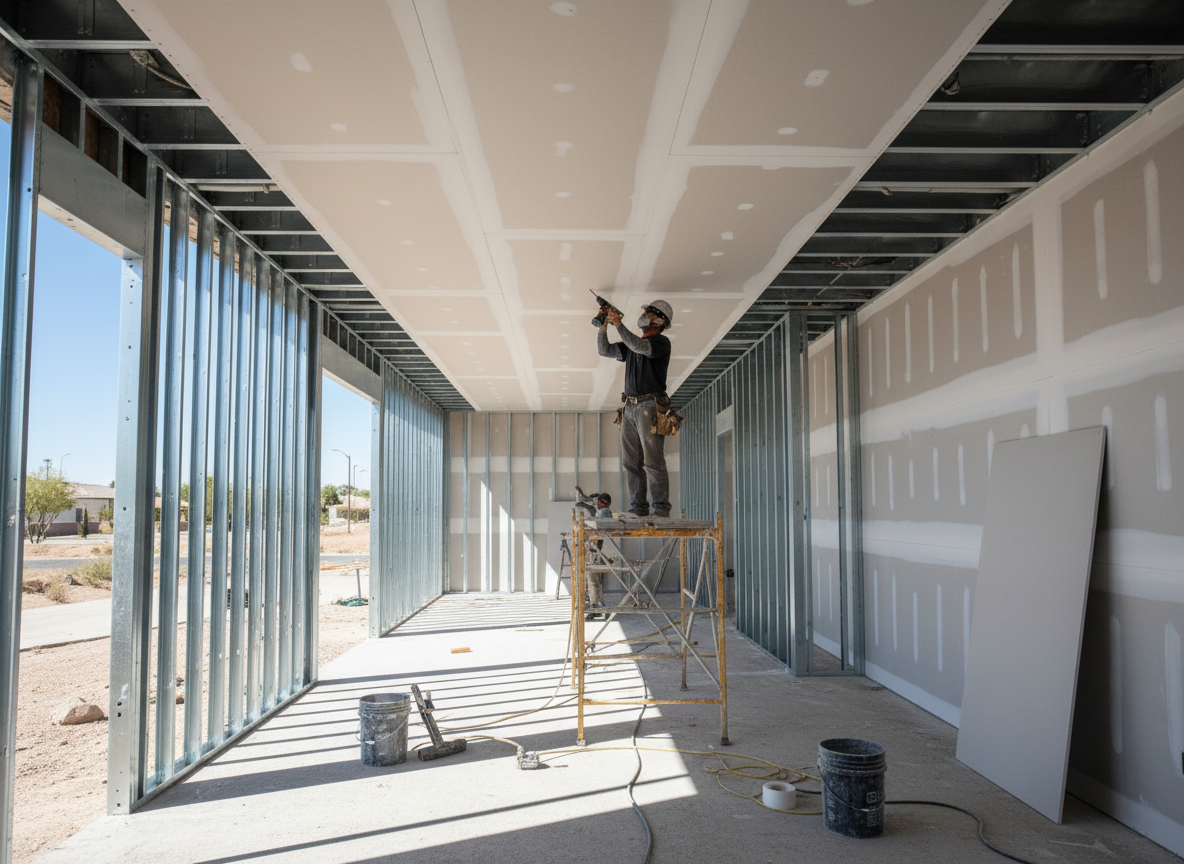
Commercial drywall work in Gilbert demands attention to rapid temperature shifts and low humidity that accelerate joint compound drying and increase cracking risk along seams. Crews working in buildings near Gilbert Regional Park or Heritage Court often contend with dust infiltration from surrounding desert terrain that requires extra sealing steps before taping. Maricopa County commercial codes emphasize fire-rated assemblies in retail and office spaces, so material choices must match specific occupancy ratings rather than standard residential board.
Projects in neighborhoods like Agritopia and San Tan Ranch frequently involve retrofits of existing metal stud walls where prior moisture exposure from irrigation or monsoon runoff has weakened substrate. Installers must verify framing integrity and sometimes add moisture barriers before hanging new sheets. In Layne Heights commercial strips, tight access around parking structures means staging materials in smaller loads to avoid disrupting tenant operations during daytime hours.
Edge cases include matching textured finishes on older commercial stock in Downtown Gilbert where original knockdown patterns vary by decade of construction. Heat expansion joints must be planned every twenty feet in long corridors to prevent buckling once summer temperatures exceed one hundred ten degrees. Proper ventilation during sanding prevents fine gypsum dust from migrating into HVAC systems serving multiple suites.
Technician insight
In Gilbert, the thing that catches most people out with Commercial Drywall Contractor is how quickly joint compound skins over once afternoon temperatures hit one hundred five degrees near the Riparian Preserve job sites. Crews have to mix smaller batches and work in shaded sections or the seams telegraph later.
Downtown Gilbert Office Build-Out
A retail space near Heritage Court needed new partitions after a tenant change. Existing walls showed prior water staining from roof leaks common in older commercial stock. We removed damaged sections, installed moisture-resistant board with proper vapor retarders, and added expansion joints before finishing to match surrounding texture.
How it works
- 1
Site Assessment
Measure walls and ceilings, note existing conditions, and review fire code requirements for the specific commercial occupancy in Gilbert.
- 2
Material Selection
Choose type X or moisture-resistant board based on location and exposure, accounting for desert heat effects on adhesives and compound.
- 3
Installation
Hang and fasten sheets to metal or wood studs, install control joints where needed, and tape with setting-type compound suited to rapid drying.
- 4
Finishing and Cleanup
Apply texture or smooth finish, sand, and vacuum dust thoroughly before turnover to avoid contamination of tenant spaces.
Pricing
Upfront quotes based on square footage, board type, and access constraints; no hidden fees.